
Families are central to all we do here at Capita—in fact, helping families and their communities flourish is our mission. Martin Luther King Jr. once offered that:
family life not only educates in general, but its quality ultimately determines the individual’s capacity to love. The institution of the family is decisive in determining not only if a person has the capacity to love another individual, but in the larger social sense, whether he is capable of loving his fellow men collectively. The whole of society rests on this foundation for stability, understanding, and social peace.
The well-being of families is not merely a concern for those individuals in the household but also a public concern.
Our Vision of Family Policy
Capita defines family policy as the sum of laws and regulations that shape the enabling conditions for (or against) widespread family flourishing.  Capita has an ambitious global vision: a future in which families can flourish in just, peaceful, and prosperous communities on a healthy, safe, and clean planet. This vision is central to all of our work. We call for a society that provides the foundational requirements of human flourishing (education, nurturance, and health; artistic, cultural, and economic assets; mental and spiritual well-being; and the ability to contribute meaningfully as citizens) to all people, and in which all people contribute to their fullest capacity—regardless of class, race, creed, gender, sexuality, ability, or age. Society need not be a ruthless competition for scarce resources.
When we think about family policy, Capita uses two helpful frameworks. One comes from family policy scholar Karen Bogenschneider, featuring different layers:
- Direct family policy is any policy that directly affects family outcomes, such as the various responsibilities and functions that families perform for the well-being of their members and society, including family formation, partner relationships, economic support, child-rearing, and caregiving. Examples: laws and regulations related to paid family leave, child care, family caregiving for older adults, and tax credits targeted to families.
- Indirect family policy is any policy that directly addresses individual needs and well-being but also indirectly affects family outcomes. Examples: policies targeted to individuals, including health policies such as Medicaid and food security policies such as SNAP.
- A family impact lens is a way of thinking and a frame for viewing the world that moves beyond what policy or program is enacted or established to how or why it impacts family functioning and whether there are disparate effects on different types of families. Examples: considering policies on predictable job schedules or sports betting from the perspective of their impact on families.
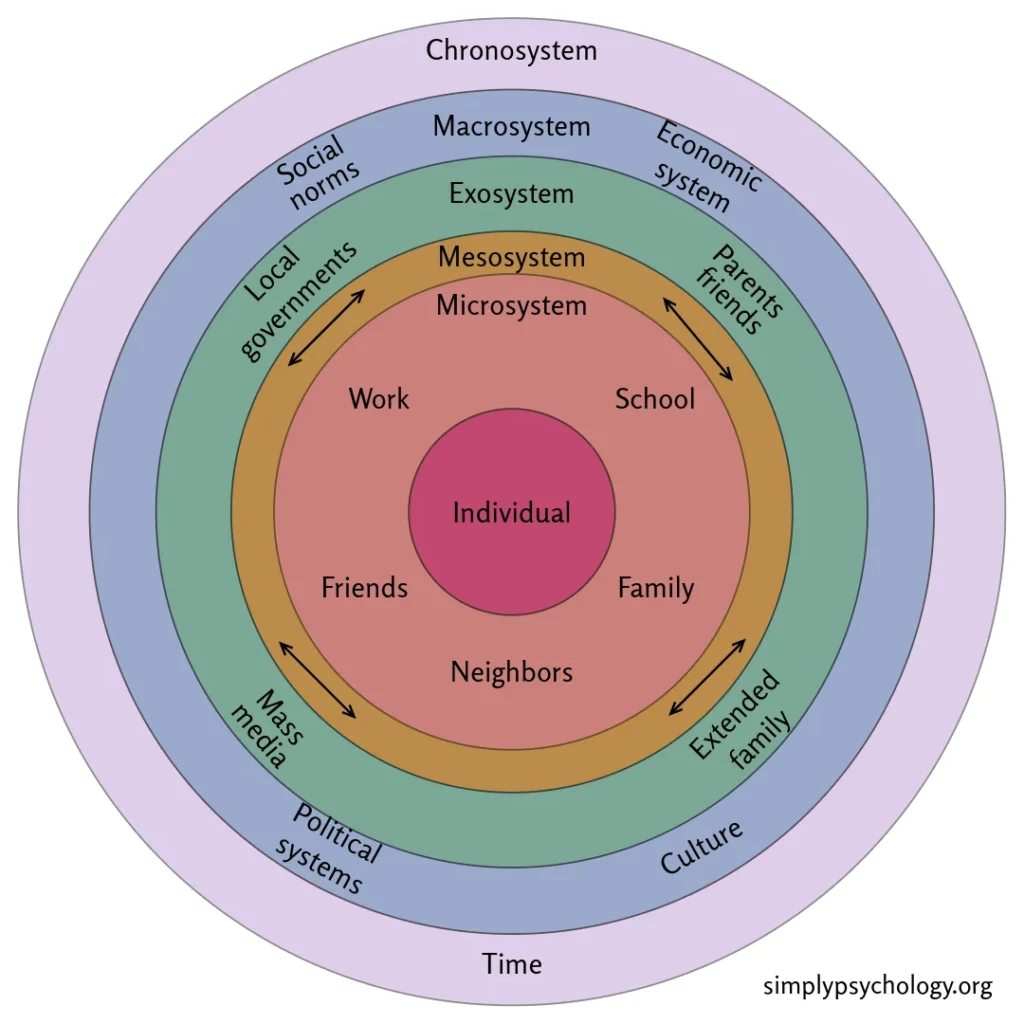
This conception of family policy also aligns with the second framework Capita relies on, the ecological systems theory of child development first posited by renowned scholar Urie Bronfenbrenner. In the figure that follows, Bronfenbrenner conceptualizes children’s development: not through predetermined, automatic steps but rather through complex, bidirectional interactions with their social and physical environments. Of these environmental factors, the family looms by far the largest. As Bronfenbrenner once wrote, his research findings “point to approaches that are family-centered rather than child-centered, that cut across contexts rather than being confined to a single setting, that have continuity through time, and that utilize as the primary agents of socialization the child’s own parents, other family members, adults and other children from the neighborhood in which he lives, school personnel, and other persons who are part of the child’s enduring environment.”
This ecological approach has important implications for public policy. Viewing public policy through the lens of families counters narrow, individualistic agendas by, as Bogenschneider writes, “moving away from a concentration on overly specific problems or single solutions and toward a more holistic, altruistic, multidimensional way of thinking. This family-centered view can broaden political discourse by adopting a lifespan perspective that extends from the cradle to the grave in the only social sphere that encompasses multiple generations.”
Policy vs. Programs
At Capita, we’re also careful to distinguish between policy and program. A policy is not better or worse than a program, and vice versa; rather, they describe different levels of organization in efforts to address a given issue or population. As Daniel Patrick Moynihan once put it, “Programs relate to a single part of the system; policy seeks to respond to the system in its entirety.” Applied well, high-level policy objectives naturally lead to aligned and coordinated programs that maximize the chances of those objectives being met.
A simple way to understand this is to look beyond the family. The development and production of the F-35 fighter jet is a program. The National Defense Strategy is a policy. The totality of the U.S. goals regarding the world beyond our borders is a foreign policy. Sometimes policies are set by the president, while in many cases, as with the Employment Act of 1946 or the Older Americans Act of 1965, the U.S. Congress has laid out national policy objectives.
Moynihan further noted that the U.S. had never had a national family policy. That remains true. Thus, Head Start, WIC, home visiting, and Medicaid’s In-Home Supportive Services are programs, but they do not nest under the umbrella of any unifying policy goals. As Moynihan concluded, this gap is partially because U.S. social policies tend to “pertain to the individual, and only in the rarest circumstances do they define the family as the relevant unit.”
The Opportunity Ahead
Because family is such a widely held value by Americans of all backgrounds and beliefs, family policy also offers the potential to rise above partisan politics and foster common ground. Public policies are indelibly shaping American family life whether one likes it or not—the question is whether the government will take intentional steps to maximize the chances that the consequences are positive.
The United States is long past overdue, then, for a robust and comprehensive family policy under which to align its many well-meaning social programs and through which to apply a family lens to all aspects of public policy. Capita’s Family Policy Lab aims to make family policy a reality in the U.S.
Note: We are indebted to Family Policy Lab advisory council member Karen Bogenschneider, professor emeritus of human ecology at the University of Wisconsin-Madison and author of the definitive volume Family Policy Matters, for much of the thought here.