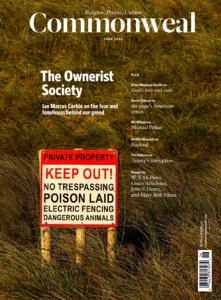
 At its most fundamental level, economists tell us, ownership is “the right to exclude.” It sets up boundaries and allows the owner to decide who may cross them. My possession is truly mine—the thing and I somehow belong together—precisely to the degree that I can bar you from access to it. This is an oddly negative vision of having and belonging, of course, but at least it is clear and simple. Ownership has, however, taken on a deeper meaning in our time and place. Much more than a regime governing access to property, ownership is now the primary way that many seek to belong, to be at home in the world.
A whole cultural paradigm has grown up around the fetishization of ownership. We might call this paradigm “ownerism”—a view of the world that pictures ownership as identity-conferring, indexed to the individual, and unbounded by duty. Ownerism has permeated many aspects of American life in the twenty-first century, and has come to seem simply natural to us: of course each of us always wants more for ourselves, and of course we will each grab and keep as much as we can, however we can; this has come to seem like bare human nature. It is not. Many outside observers have commented on the strange, sometimes pathological, nature of ownerist culture. The Oglala Sioux Medicine Man Black Elk, ruminating on the encroachment of this culture on the Lakota people, reported what he found on his first trip to New York City:
I could see that the Wasichus [white men] did not care for each other the way our people did before the nation’s hoop was broken. They would take everything from each other if they could, and so there were some who had more of everything than they could use, while crowds of people had nothing at all and maybe were starving. This could not be better than the old ways of my people.
If many of us assume that a large percentage of people would indeed take everything from their neighbor if they could, we would do well to remember that a broad swath of humanity has found this an unaccountably strange way to live.
