
A mom walks into a school to drop off her five-year-old son for the first day of kindergarten. But any first day jitters are minimal. Instead, both mother and son feel a sense of ease and excitement.
For several years, the mom and son have been meeting other families, the principal, and kindergarten teachers at school-connected play-and-learn groups. Since her son’s birth, the mom has appreciated how “trusted messengers”—pediatricians, home visitors, librarians, early childhood educators, and kindergarten teachers—have all shared the same basic parenting guidelines with her. She has spoken with advisors based at the school (“navigators”) about child care and health services.
The mom first met the principal at the community-based pre-K program her son attended. And she and her son have enjoyed transition-to-kindergarten activities. At these events, the child met teachers, played with new friends, and received books and materials while the mom learned about kindergarten and how to prepare her son. The son has already ridden the school bus from preschool and visited kindergarten classrooms.
For this family, school is not a scary new place. It is part of a connected community. The mom and the child feel at home at school. Unfortunately, in most communities this is not the experience.
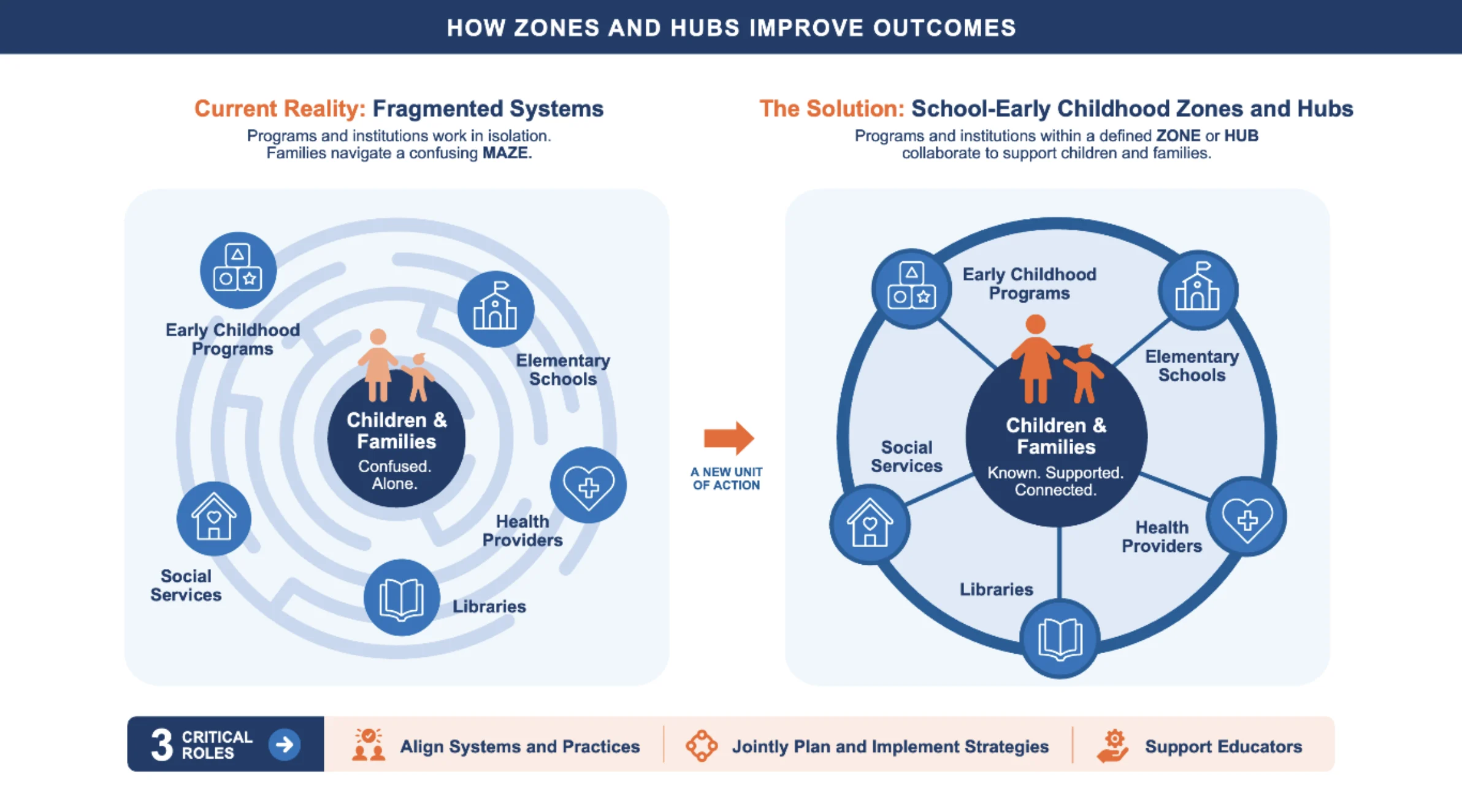
Across the United States, early childhood programs, elementary schools, health care, and family-serving agencies operate side by side yet in isolation. Families must find their way in a confusing obstacle course of services. Educators work hard but often with wide separation between early childhood programs and schools. Even in communities with strong individual programs, the overall system feels fragmented.
This fragmentation is damaging. It interrupts learning, relationships, and support at a critical developmental stage. Access to high-quality programs is essential, but unless those programs work together, they cannot deliver their full impact.
The Limits of Programmatic Reform
For decades, early childhood policymakers and practitioners have focused on improving individual programs. This includes expanding access to early childhood education, raising standards, strengthening curricula, and investing in the workforce. These efforts are essential, and they have produced meaningful gains. But they are not sufficient.
The period from birth through elementary school represents a uniquely sensitive window for development.
A growing body of research points to two foundational principles. First, the early years matter profoundly. The period from birth through elementary school represents a uniquely sensitive window for development.  National Research Council and Institute of Medicine, From Neurons to Neighborhoods: The Science of Early Childhood Development; Heckman, Giving Kids a Fair Chance: A Strategy That Works.
Second, place matters. Children’s long-term outcomes vary dramatically across neighborhoods, even when family income is held constant. Communities characterized by stronger social cohesion and institutional connectedness produce better outcomes across a wide range of measures. Raj Chetty and Nathaniel Hendron, “The Impacts of Neighborhoods on Intergenerational Mobility I: Childhood Exposure Effects,” Quarterly Journal of Economics 113, no. 3 (2018), opportunityinsights.org/wp-content/uploads/2018/03/movers_paper1.pdf; “Neighborhoods matter: Children’s lives are shaped by the neighborhood they grow up in,” Opportunity Insights, Harvard University, 2025, opportunityinsights.org/neighborhoods/. Robert J. Sampson, Great American City: Chicago and the Enduring Neighborhood Effect (Chicago, IL: The University of Chicago, 2012).
Taken together, these findings suggest that to improve outcomes we must do more than strengthen individual programs. We need to strengthen how those programs function together within communities to create a consistent continuum of support. National Research Council and Institute of Medicine, Transforming the Workforce for Children Birth Through Age 8: A Unifying Foundation (Washington, DC: The National Academies Press, 2015); Kristie Kauerz and Julia Coffman, Framework for planning, implementing, and evaluating prek-3rd grade approaches (Seattle, WA: College of Education, University of Washington, 2013). We need well-functioning early learning ecosystems. Joan Lombardi, “From Program to Place: A Community Systems Approach to Supporting Young Children and Families,” Stanford University, 2024, earlychildhood.stanford.edu/news/program-place-community-systems-approach-supporting-young-children-and-families. Philip A. Fisher and Joan Lombardi, The new ecology of early childhood: Revisiting Bronfenbrenner’s theory in the context of contemporary challenges and opportunities (Childhood Stanford Center on Early, 2025); Elliott Haspel Patrick T. Brown, Hospitable by Design: Toward Institutions and Communities That Welcome Families (Capita, 4.21.2026 2026 ), capita.org/publication/hospitable-by-design-toward-institutions-and-communities-that-welcome-families/. Yet most communities lack structures to support this kind of sustained, connected, cross-sector collaboration.
Early childhood programs, schools, and social services are typically structured as separate domains, governed by different funding streams, accountability systems, and professional norms. Abrupt and confusing transitions from preschool to school can slow learning and development in the early years of school. Communities often offer services that many parents do not know how to access. The result is a system that works harder than it needs to—and delivers less than it could.
From Fragmented Programs to a Connected School-Community Infrastructure
School–early childhood zones and hubs organize existing institutions around shared geography and shared responsibility for children and families. Joan Lombardi, “Early Opportunity Zones: Communities Bringing It All Together for Young Children and Families,” Nurture Connection May 20, 2026, 2025, nurtureconnection.org/early-opportunity-zones/. C. O’Connor and R. E. Hernández, Early learning community action guide and assesment tool (Policy Center for the Study of Social, 2024), cssp.org/wp-content/uploads/2025/03/ELN_CSSP_ActionGuide_2024_DIGITAL_FINAL.pdf.
Zones and hubs can include representation from the full gamut of early childhood providers in a community.
A zone typically includes multiple elementary schools, local early childhood programs, and a network of community partners within a defined area. A hub centers on a single elementary school and its surrounding early childhood providers and services. Zones and hubs can include representation from the full gamut of early childhood providers in a community, including faith-based and family child care providers in addition to Head Start, state-funded pre-K, and other larger centers. The family supports they provide address the needs of all children in the community, including those with stay-at-home parents and those in formal care.
Zones and hubs function as close-to-the-ground, family-focused partnerships that enable three forms of action that rarely occur together otherwise:
- Aligning systems and practices across early childhood, elementary education, and family-serving agencies
- Jointly planning and implementing strategies that directly support children and families
- Supporting early years educators in cross-sector communities of practice.
Zones and hubs are not new programs. They are new infrastructure, the connective tissue that allows existing programs to function as a system rather than a collection of parts.
Zones and hubs can work hand in hand with other types of cross-sector collaborations. For instance, they advance the goals of children’s cabinets and regional early childhood partnerships by providing local structures focused on concrete, complementary strategies. They extend full-service community schools “Community Schools Forward “, National Center for Community Schools, 2026, nccs.org/community-schools-forward/. by supporting nearby families with young children, connecting to local early childhood programs, and strengthening transitions and collaboration across grade levels. They further cradle-to-career initiatives John Kania and Mark Kramer, “Collective Impact,” Stanford Social Innovation Review 9, no. 1 (2011), ssir.org/articles/entry/collective_impact; “Harlem Children’s Zone,” 2026, hcz.org; “StriveTogether,” 2026, strivetogether.org. by promoting continuity and alignment across early childhood and elementary education and by fostering high-quality joint professional learning for early years teachers.
Proof of Concept: The First 10 Example
Several models of school–early childhood zones and hubs are underway across the country. David Jacobson, All Children Learn and Thrive: Building First 10 Schools and Communities (Waltham, MA: Education Development Center, 2019. “Superintendents’ Early Childhood Plan,” Buffett Early Childhood Institute, 2026, buffettinstitute.nebraska.edu/schools/; “Our CPC P-3 Model”, Human Capital Research Collaborative, 2026, cpcp3.org/. Center for Improvement of Child Family Services Portland State University, Early Learning Multnomah’s P-3 Focus Schools: Early Insights into What, Why, and How ? (Portland, OR: Portland State University, 2017); “P-3 Schools “, 2026, www.earlylearningmultnomah.org/investments/p-3-schools. These models informed First 10, the initiative I lead, which has supported the development of zones and hubs in more than 50 communities across 6 states.
In rural districts, small cities, suburbs, and larger urban systems similar, positive patterns emerge when institutions are intentionally organized in this way.
First 10 provides a structured framework for organizing local partnerships of elementary schools, early childhood providers, and community organizations. These partnerships focus on a core set of strategies: strengthening transitions to kindergarten, aligning and improving instruction across pre-K and the early grades, partnering with and engaging families, and connecting them to services through trusted relationships. In rural districts, small cities, suburbs, and larger urban systems similar, positive patterns emerge when institutions are intentionally organized in this way.
What Becomes Possible
The experience of First 10 communities illustrates the kinds of outcomes that zones and hubs make possible.
Continuity for children.
In York City, Pennsylvania, teachers from Head Start, community-based pre-K, and district pre-K and kindergarten classrooms aligned their work around a shared early math initiative and adopted a common approach to instruction and family engagement. Across these programs, children are now benefiting from consistent expectations, language, and learning experiences as they move into kindergarten. Their teachers report stronger instructional practice and deeper engagement with families.
Access for families.
In East Providence, Rhode Island, a family navigator based in an elementary school helps families access health and social services. Because the navigator is present at school events and play-and-learn groups, families build relationships of trust and are more likely to seek support early, before challenges escalate.
Instructional collaboration.
In Russellville, Alabama, pre-K and kindergarten teachers who had never visited one another’s classrooms engaged in joint professional learning and classroom visits. They lined up their expectations for children, shared strategies, and built a strong, coherent instructional experience for children that spans the early years.
Social capital and belonging.
Across multiple communities, school-connected play-and-learn groups bring families together before kindergarten begins. The groups introduce families to schools, connect them with community organizations and resources, and just as importantly help them build relationships with one another. In a time of rising social isolation, these connections are essential to how communities support families.
These examples are the predictable result of building the connections children and families need to thrive.
The Final Vertical Leap
Educators already think vertically in many contexts. Districts align elementary school with middle school, middle school with high school, and high school with college and career pathways. But a critical connection remains underdeveloped: the link between early childhood and elementary school. Zones and hubs make this final vertical leap possible.
They enable schools to shift from a narrow focus on enrolled students to a broader role within their communities. Instead of waiting for children to arrive at the door when they turn five, schools step up and work with partners to help prepare and support children from birth. They see younger children as their soon-to-be students. They create structures through which early childhood programs and schools can work together consistently to support families.
Improving outcomes at scale requires building local systems that connect early childhood and elementary education in practice.
Toward “Our Community” Cultures
When these key connections are made, families experience something fundamentally different. They receive consistent messages about parenting and early learning. They build relationships with educators before formal schooling begins. They gain easier access to services and supports. They meet other families navigating similar experiences.
The result: Families and children feel at home at school.
Over time, these interactions contribute to what might be called an “our community” culture—a shared sense that children’s well-being is a collective responsibility and that families are partners rather than clients.
Research on social cohesion and social capital suggests that communities characterized by trust, mutual support, and strong institutional relationships produce better outcomes for children and families. Zones and hubs provide a practical mechanism for building those conditions. Opportunity Insights, “Neighborhoods matter: Children’s lives are shaped by the neighborhood they grow up in.” Robert J. Sampson, Great American City: Chicago and the Enduring Neighborhood Effect (Chicago, IL: The University of Chicago, 2012). Robert D. Putnam, Bowling alone : the collapse and revival of American community (New York: Simon & Schuster, 2000); Robert D. Putnam, Our Kids: The American Dream in Crisis (New York: Simon & Schuster, 2015). Anthony S. Bryk et al., Organizing Schools for Improvement: Lessons from Chicago (Chicago, IL: The University of Chicago Press, 2010); Mario Luis Small, Unanticipated Gains: Origins of Network Inequality in Everyday Life (New York: Oxford University Press, 2009). Joe Waters, 5 Questions with Harvard’s Mario Small (Capita, August 9, 2019), capita.org/5-questions-with-harvards-mario-luis-small.
The High Cost of Fragmentation
Without this shift, fragmentation will continue to undermine even our best efforts. We will continue to invest in strong programs that operate in isolation. We will miss opportunities to support families early. And we will struggle to create the continuity in learning across years and settings that children need. The status quo is powerfully—if unintentionally—limiting impact and harming children.
A Call for Action
School–early childhood zones and hubs offer a practical, research-based path. To dramatically improve outcomes for children and families, key players need to take coordinated action:
- School districts should adopt a long-term view of the soon-to-be-students in their communities and partner with early childhood providers and community organizations to support children and families before kindergarten.
- Policymakers and funders should invest not only in programs, but also in building an infrastructure that connects them—recognizing zones and hubs as critical units of change.
- Communities should organize their institutions around shared geography and shared responsibility, creating the conditions for coordinated action.
In short: Start early, connect institutions, organize efforts, strengthen communities, and support families so that all children can learn and thrive.
David Jacobson is Director of First 10 at Education Development Center in Boston and author of the Stanford Center on Early Childhood working paper, “Strong Communities, Thriving Children: The Power of School—Early Childhood Zones and Hubs to Drive Change.”