
In spring 2024 and fall 2025, Capita commissioned surveys of stay-at-home parents. (We describe their methodology below.)
Our definition: stay-at-home parents provide primary care during the business day for at least one child under 12 (regardless of whether they bring in income). When we listen to these parents, they tell us they are feeling financially pinched, stressed, and pessimistic about the future. We summarize our findings–many of which challenge conventional wisdom–below.
The bottom line: The family remains the basic unit of our society. Any comprehensive family policy or child care reform must include measures that help families with stay-at-home parents flourish.
Our Findings: Stay-at-Home Families Under Stress
Stay-at-Home Parents Are in a Significant Share of American Families
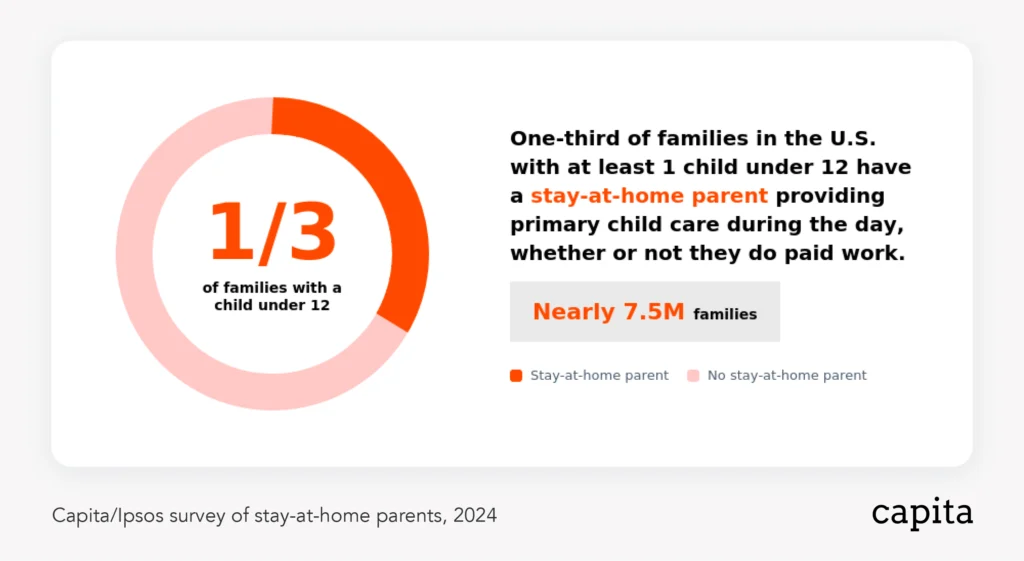
- One-third of families in the U.S. with at least 1 child under 12 have a stay-at-home parent providing primary child care during the day, whether or not they do paid work. That’s nearly 7.5 million families.
Stay-at-Home Parents Are Struggling Financially
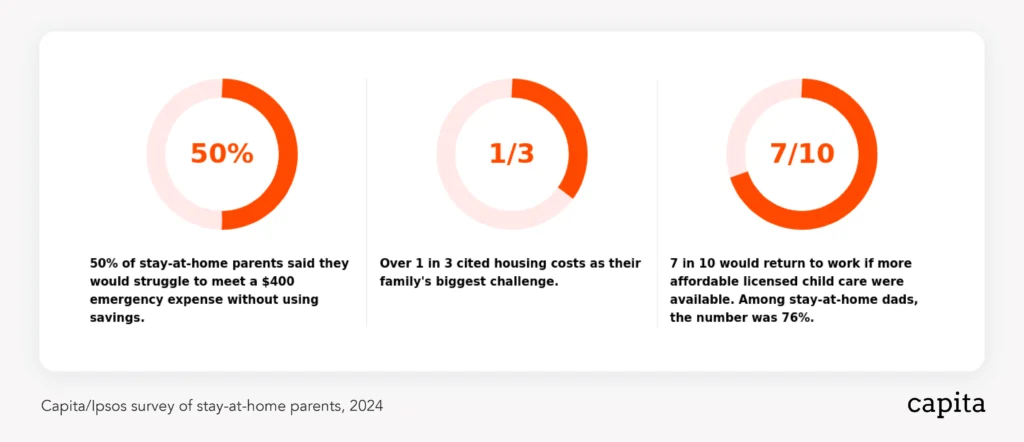
- 50% of stay-at-home parents said they would struggle to meet a $400 emergency expense without using savings.
- Over 1 in 3 cited housing costs as their family’s biggest challenge.
- 7 in 10 would return to work if more affordable licensed child care were available.
- Among stay-at-home dads, the number was 76%.
Stay-at-Home Parents Do Not Feel Respected
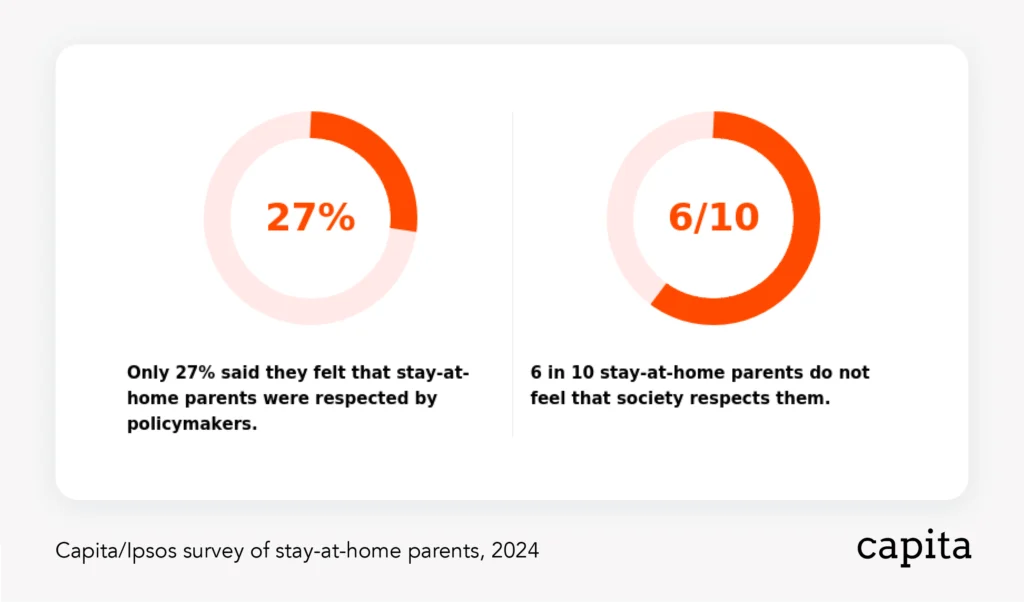
- Only 27% said they felt that stay-at-home parents were respected by policymakers.
- 6 in 10 stay-at-home parents do not feel that society respects them.
Stay-at-Home Parents Are Eager for Government Support
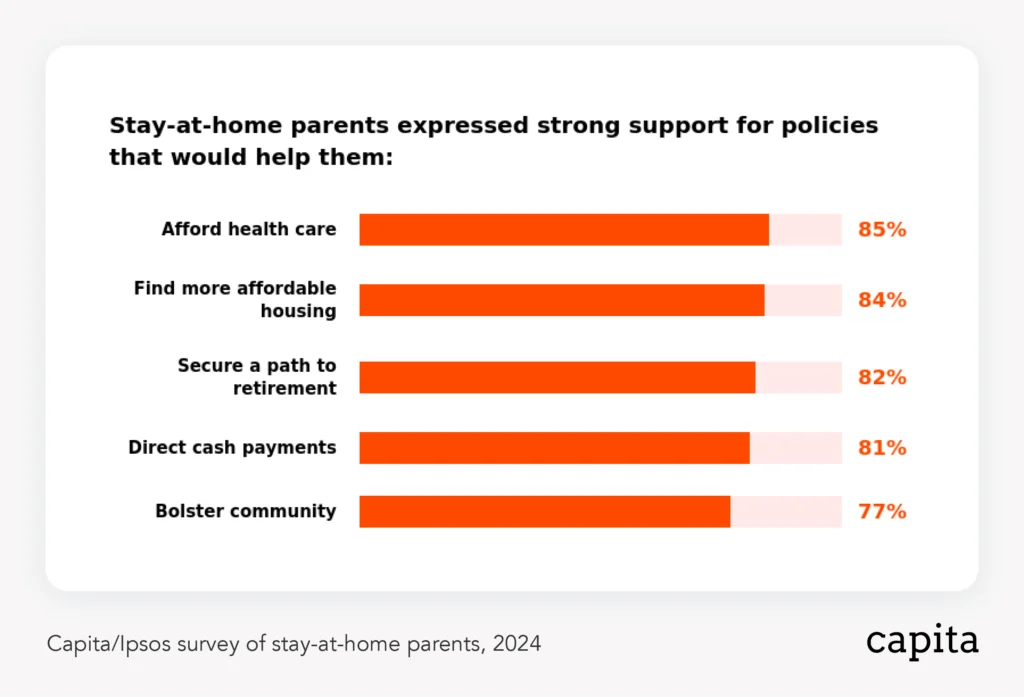
- More than 80% of parents we surveyed wanted government support in making health care and housing more affordable, as well as securing a path to retirement and providing direct cash payments.
- Nearly 9 in 10 respondents agreed that the government should do more to help families with a stay-at-home parent.
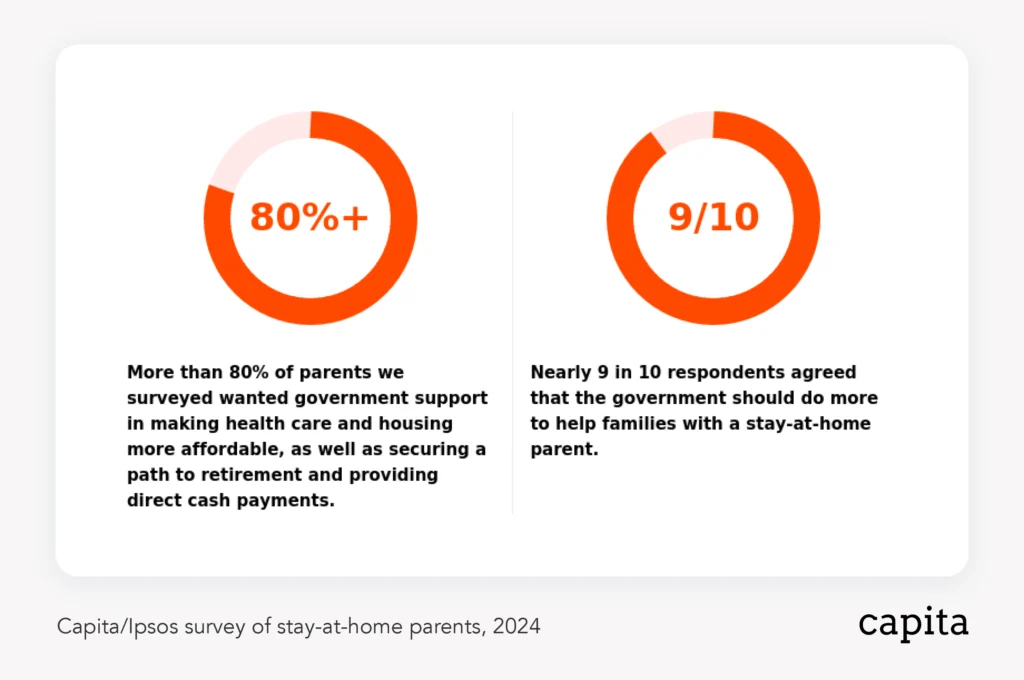
- Stay-at-home parents expressed strong support for policies that would help them afford health care (85% agree), find more affordable housing (84% agree), and secure a path to retirement (82% agree). Programs to administer direct cash payments to stay-at-home parents (81% agree) and bolster community (77% agree) were also popular.
Stay-at-Home Parents—and All Parents—Think Child Care Policy Should Support
Stay-at-Home Parents Alongside Support for Non-Parental Care Options
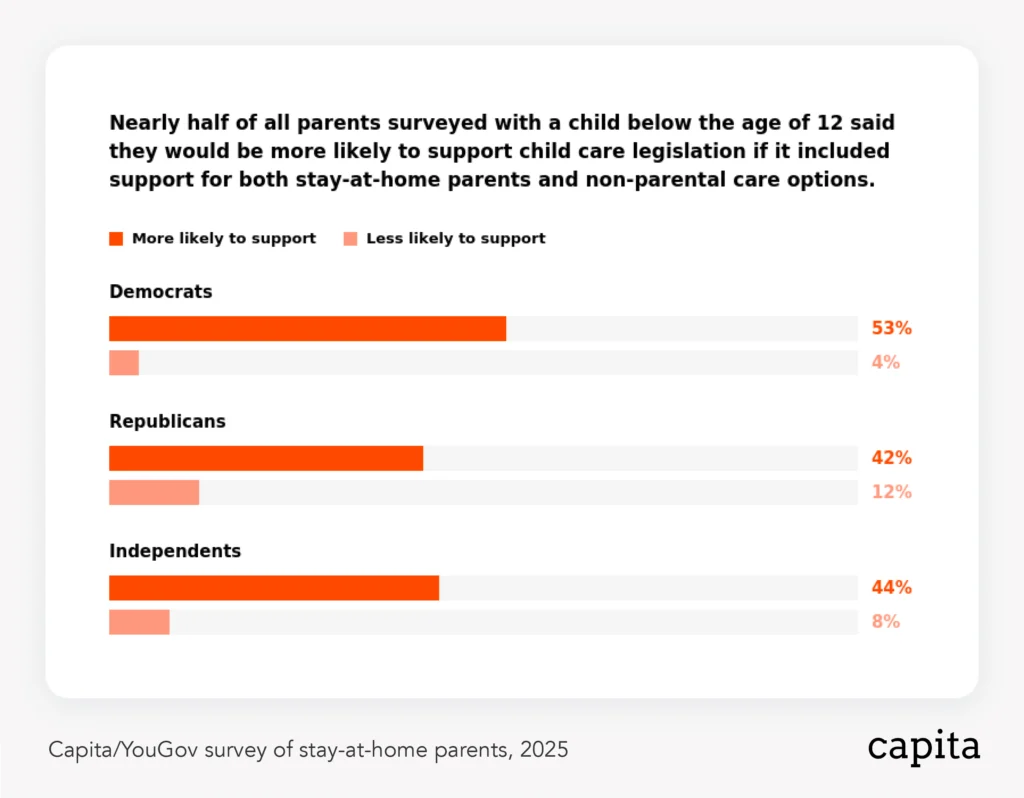
- Nearly half of all parents we surveyed with a child below the age of 12 said they would be more likely to support child care legislation if it included support for both stay-at-home parents and non-parental care options; that included 53% of Democrats, 42% of Republicans, and 44% of Independents. Only 4% of Democrats, 12% of Republicans, and 8% of Independents said it would make them less likely to support the legislation.
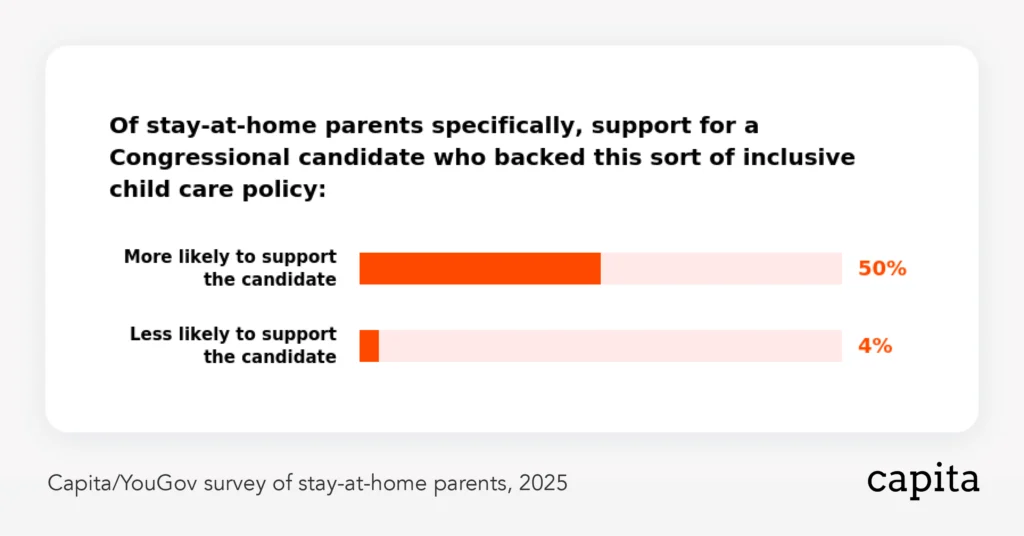
- Of stay-at-home parents specifically, 50% said they would be more likely to support a Congressional candidate who backed this sort of inclusive child care policy, with only 4% saying they would be less likely to support the candidate.
Stay-at-Home Parents Need—But Lack—Access to Child Care
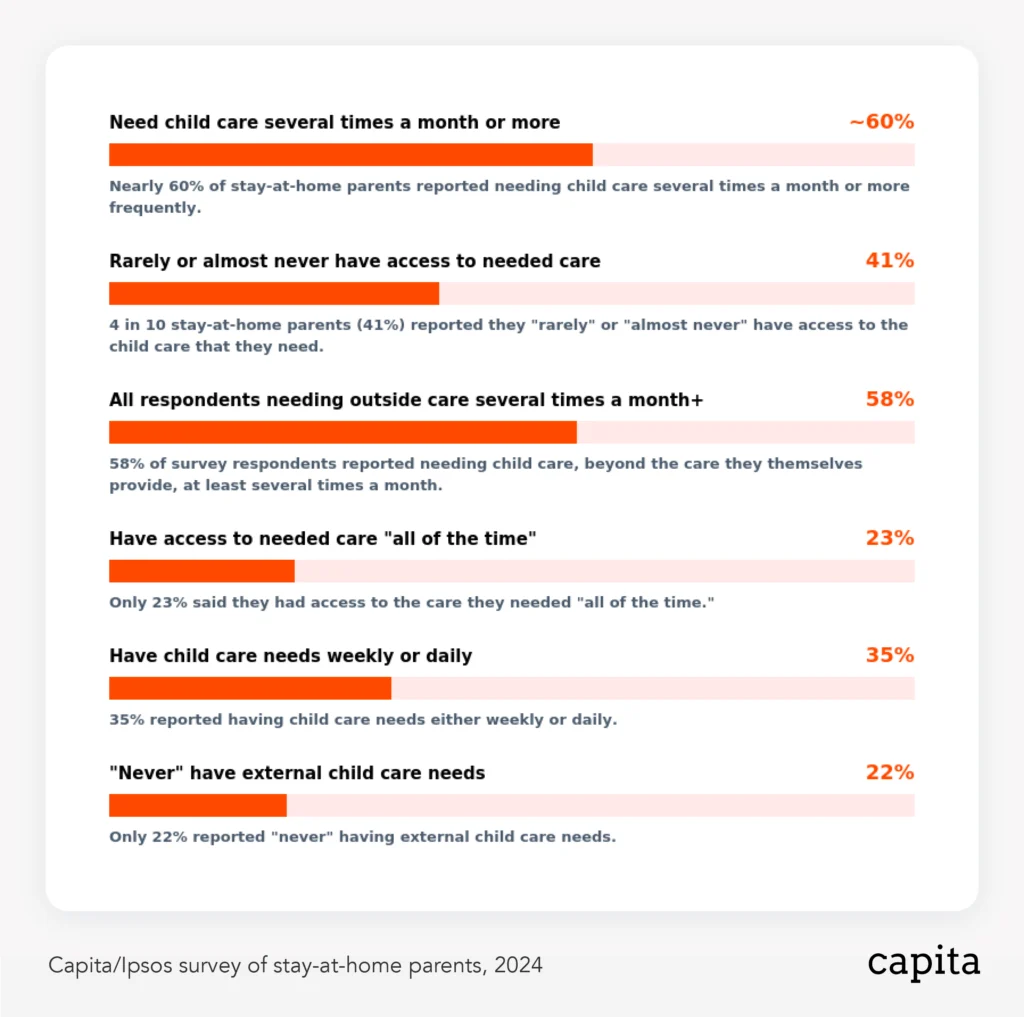
- Nearly 60% of stay-at-home parents reported needing child care several times a month or more frequently. However, 4 in 10 stay-at-home parents (41%) reported they “rarely” or “almost never” have access to the child care that they need.
- 58% of survey respondents reported needing child care, beyond the care they themselves provide, at least several times a month.
- Only 23% said they had access to the care they needed “all of the time.”
- 35% reported having child care needs either weekly or daily.
- Only 22% reported “never” having external child care needs.
Stay-at-Home Parents Lack Community Support
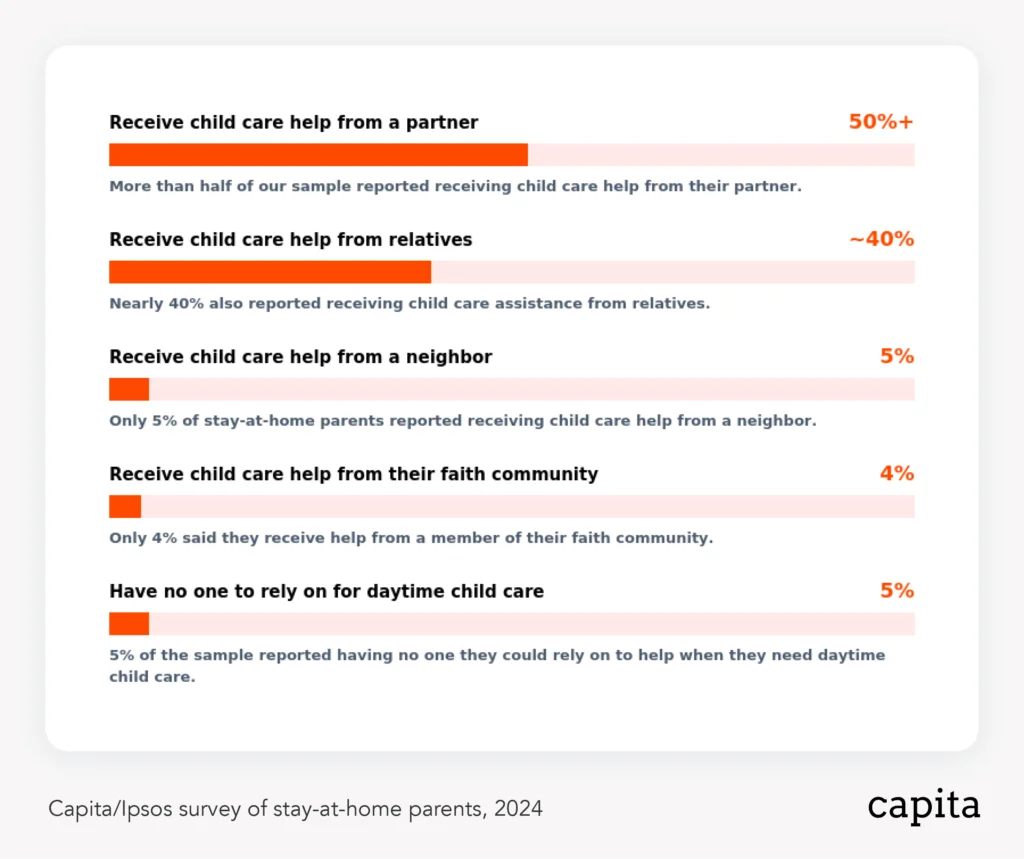
- More than half of our sample reported receiving child care help from their partner and nearly 40% also reported receiving child care assistance from relatives.
- However, only 5% of stay-at-home parents reported receiving child care help from a neighbor, and only 4% said they receive help from a member of their faith community.
- Further, 5% of the sample reported having no one they could rely on to help when they need daytime child care.
Paid Work Is Common, and Many Parents Would Work More If They Could
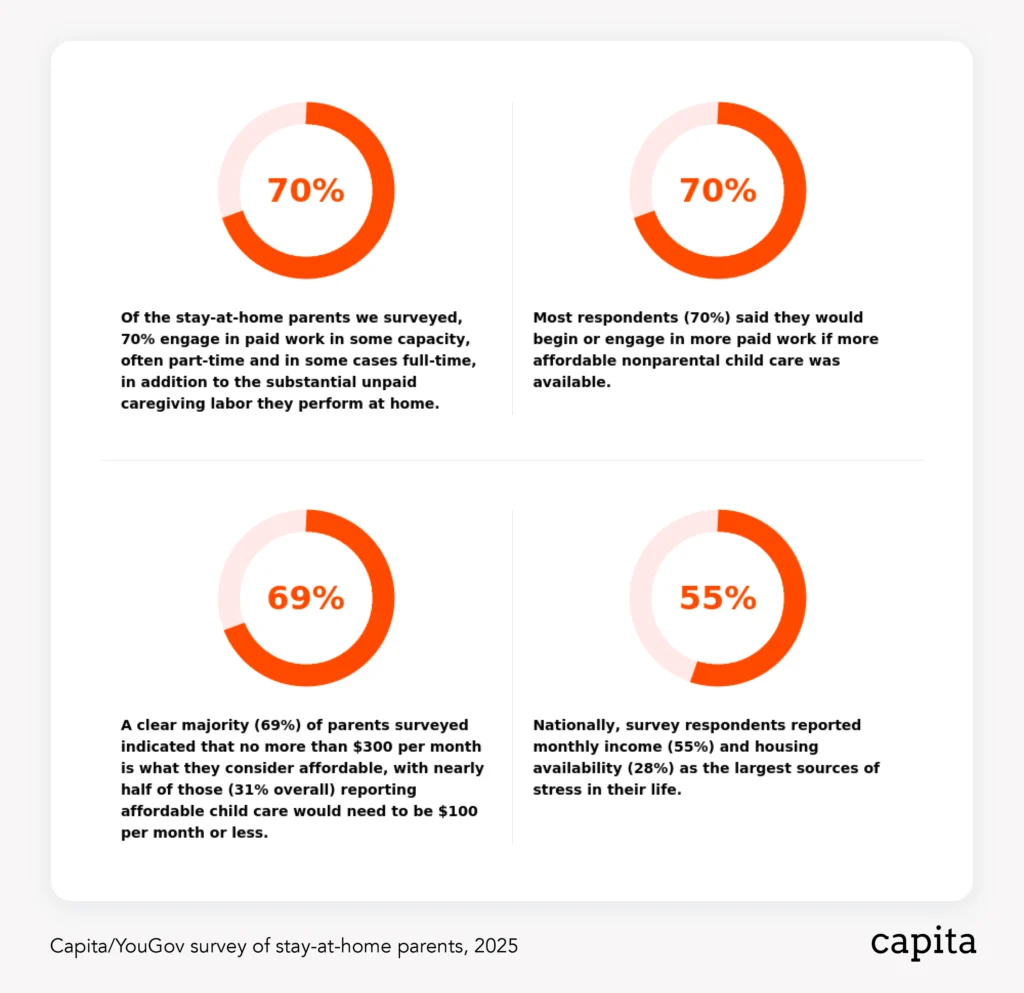
- Of the stay-at-home parents we surveyed, 70% engage in paid work in some capacity, often part-time and in some cases full-time, in addition to the substantial unpaid caregiving labor they perform at home.
- Most respondents (70%) said they would begin or engage in more paid work if more affordable nonparental child care was available.
- In fact, half of the stay-at-home parents said they wanted a paid job but were at least partially stymied by the lack of affordable and accessible child care.
- A clear majority (69%) of parents surveyed indicated that no more than $300 per month is what they consider affordable, with nearly half of those (31% overall) reporting affordable child care would need to be $100 per month or less.
- Nationally, survey respondents reported monthly income (55%) and housing availability (28%) as the largest sources of stress in their life that, if addressed, would most significantly improve their life satisfaction.
Child Care Options Do Not Match What Many Parents Want or Need
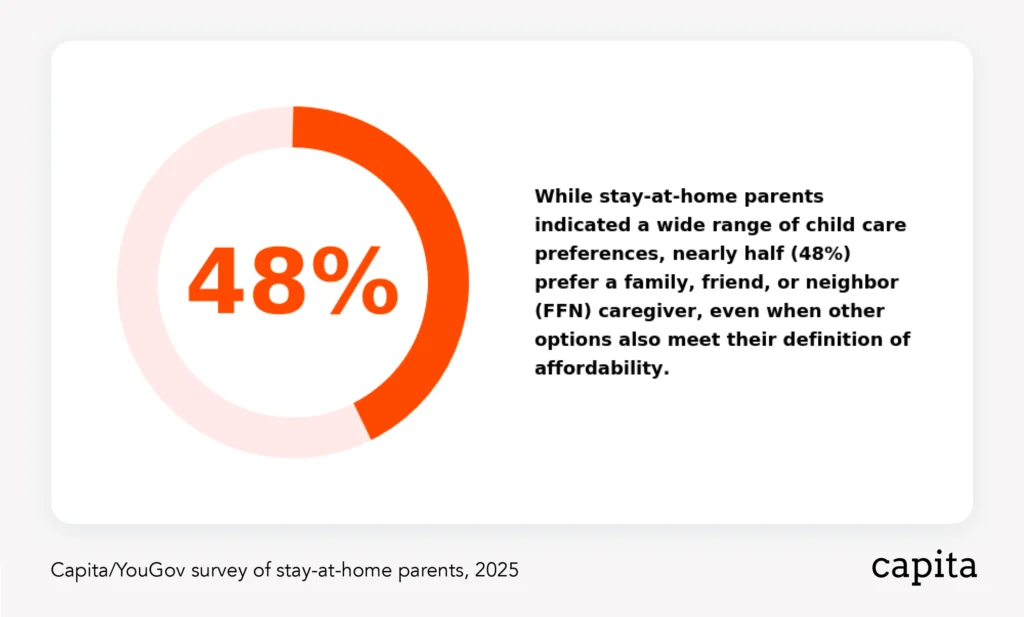
- While stay-at-home parents indicated a wide range of child care preferences, nearly half (48%) prefer a family, friend, or neighbor (FFN) caregiver, even when other options also meet their definition of affordability.
Families Need Genuine Options, Not Impossible Choices
Stay-at-home parents contribute significantly to society yet are undervalued and struggling.
Our findings challenge conventional wisdom about these parents. Most are not wealthy; in fact, many face significant financial strain. They are diverse and have diverse reasons for wanting to be home. They have child care needs–and many needs beyond child care, from affordable housing and health care to simple respect.
This is a bipartisan issue. Stay-at-home parents are fairly evenly divided across the political spectrum and there is interest in helping them on both sides of the aisle.
Parents want the freedom to work and raise their children in ways that align with their values, rather than being forced into rigid, unsuitable systems that dictate their choices. What parents are asking for should be basic: more time, more options, and the opportunity to make decisions rooted in their values and what is best for their family, rather than out of compulsion or, in some cases, desperation. This is not just about meeting the personal preferences of stay-at-home parents, but also about whether our economic and care systems can provide families with the stability, dignity, and predictability required for our nation to thrive.
Survey methodology
Survey 1: May 2024, administered by the polling firm Ipsos
Ipsos surveyed stay-at-home parents with children 0-12 years old. This survey reached a nationally representative sample of 1,502 stay-at-home parents and asked about their experiences and preferences. It was conducted on Ipsos’s non-probability iSay online panel in May 2024, with results analyzed from weighted responses of 1,287 parents of children ages 0-12 who report they are stay-at-home parents (defined as a parent that provides primary child care during the day for at least one child 12 or under). The starting sample was of parents of children ages 0-12, weighted by gender, age, race/ethnicity, and region.
Survey 2: October 7- November 6, 2025 and October 31-November 13, 2025, conducted by YouGov
These two national surveys totaled 3,203 parents with children under age 12, including oversamples in North Carolina, Michigan, and New Jersey. Additional screening criteria were used to identify and survey 1,000 stay-at-home parents nationally, including oversamples in the selected states.